Showing posts with label Horror History. Show all posts

Thursday, October 27, 2016

SlashDance: Nightmare City (1980)

Banner SlashDance final

There was a time in the ‘80s where aerobics was so popular that the fashion and rhythmic aerobic moves integrated itself into anything and everything one could imagine. Naturally, this would eventually lead to aerobics making its way to film, specifically the horror genre. While there are plenty of examples of aerobics in horror (Death Spa, Aerobicide, Murder Rock, Slash Dance, etc), one of the most memorable comes from a small but incredible dance scene in Umberto Lenzi’s pseudo-zombie opus Nightmare City.

Nightmare-City-1980 city of the walking deadThis scene in question takes place in a television studio, where a number of beautiful women adorned in powder blue leotards erotically erratically dance in a fashion that, despite their best efforts, lacks any sort of synchronization. I would assume the standards would be higher for TV, but then again, the fact that people actually watch a show where women wearing blue spandex perform aerobic inspired dance moves on a set designed by Milton Bradley only proves that people will watch anything. Considering that shows like MTV’s The Grind actually existed, I probably should have never even questioned it.

In any event, the song used for this moment is titled Sustain, and is provided by legendary Italian composer Stelvio Cipriani. The tune is gleefully upbeat in a fashion that makes one want to put on a pair of roller skates and glide through the streets of 1980’s New York while eating an ice cream cone. Of course, a bunch of nice looking ladies in blue onesies is innocent enough, therefore the song is quite fitting; however, things take a frightening turn when the dead body of one of the aerobiciders (that’s a fake word… feel free to use it) is discovered. At this point all hell breaks loose, as a gang of radioactively infected zombies come bursting into the studio, violently attacking everyone in sight and in a variety of grisly ways.

This scene works for a number of reasons, the main one being the fact that it’s so completely ridiculous. Regardless, it has a way of tapping into a fear; a fear of being overwhelmed by madness without any warning; a fear of being suddenly vulnerable in a place that should be safe, which in this case is at work. Sure, the “infected” are wearing bad suits and their makeup looks like puked up breakfast cereal smeared on their faces, but the dance sequence and subsequent attack scene are a highlight of a film that, despite my enjoyment, is a little uneventful.

Thursday, October 6, 2016

SlashDance: Night of the Demons (1988)

Banner SlashDance final

Stashed within the confines of Kevin Tenney’s Night of the Demons is a moment where time almost seems to stop, making way for a dance sequence so memorable that it was an easy choice when deciding on the inaugural entry of SlashDance. The setting is Hull House, where a bewildered Sal (Billy Gallo) watches as a demon possessed Angela (Amelia Kinkade) goes into a dance so decadent that even the devil himself cannot help but blush.

night_of_the_demons 1988Despite being strange in the eyes of the straight-laced Sal, the dance seems innocent enough at first, as Angela erotically tosses her body about to the beat of her own demonic drum. Things become a little more interesting, however, when a boombox mysteriously kicks on, and the screeching sounds of Bauhaus’ Stigmata Martyr come hurtling from the speakers. The sequence grows progressively intense and hypnotic in a way that is in tune with the music blaring from the sticker-laden boombox, as Angela spins herself and the viewer alike into a seductive trance of sexual chaos.

What makes this dance scene work so well is simply in the way it’s brought to life. Not only is Amelia Kinkade an incredible dancer and Stigmata Martyr the perfect song, the sequence is impressively constructed. This is most notable when the strobe light kicks on, something that adds a pulsating level of drama to Angela’s movements. It’s obvious that there are a few randomly cut frames that make it look as if Angela is quickly disappearing and reappearing in different places, something that makes the dance even more hypnotically confusing for both Sal and the audience alike.

While Night of the Demons is a fairly hokey, albeit entertaining ‘80s horror romp, the Stigmata Martyr dance scene stands out as an interesting achievement that elevates past the film itself, leaving an iconic imprint on the genre. It’s a moment that transcends the film as a whole, and that’s saying a lot considering we are talking about a movie where Linnea Quigley partakes in a memorable lipstick nipple breach.

Sunday, January 31, 2016

Anatomy of A Murder Scene: Blood Feast (1963)


Blood Feast opens in what is either an homage to Psycho or a complete rebellion against it. The setting is virtually identical, taking place in a bathroom where a familiarly beautiful blond woman (Sandra Sinclair) is taking a bath. As the woman settles in for a nice long soak, a knife-wielding madman attacks the woman as she screams in agony and fear as her life quickly escapes her body. Immediately after his victim’s final breath, the man takes a brief moment to take in what he has just done, at which point a sadistic grin forms on his face in a fashion that could either come from pride for a job well done, or the happiness knowing what bloodshed was still to come.

The camera then takes a few moments to pan across the carnage, revealing the woman’s lifeless body, strategically covered in soap suds in a way that allows just enough of her breasts to peak through and possibly titillate certain viewers. More importantly, though, this is where it is revealed that the killer, Fuad Ramses (Mal Arnold), has removed the woman’s left eyeball, showing what would have only been imagined by the audience up until this point in genre cinema.


With so much grotesquery and carnage, this might have been a perfectly suitable way to end an opening murder scene, especially in 1963. However, this is only the start of what Ramses has planned for his victim, as he then goes on to hack away at her left leg until it is completely dismembered. Ramses then places his new possession into a black duffle bag, carefully cleans off his weapon and leaves the viewer to linger on the woman’s bloodied hand, no longer having the life force necessary to resist gravity, as it slowly slides down the side of the bathtub, leaving behind a streak of viscera.

Herschell Gordon Lewis’ Blood Feast did what no other film had done before, in that it showed on-screen violence and the gore that came with it, albeit in the crudest of ways in comparison to today’s standards of filmmaking. I find it utterly fascinating how Lewis opens Blood Feast with a scene that is, in essence, a dirtier reflection of Psycho, which had come only 3 years earlier. Hitchcock made us believe we were seeing Janet Leigh as Marion Crane be murdered on screen with expert editing, brutal sound design and an ear piercing soundtrack, though never was there any penetration shown, let alone much actual bloodshed.

Psycho’s shower scene is one of the greatest and most respected on screen deaths in cinema history, and that is due to the audience's’ imagination being allowed to work overtime, filling in the gaps of of what Hitch showed them. By the time we would get to 1963, and Herschell Gordon Lewis was looking to get people’s butts in theater seats, he had to do something that no one had done before. And that’s exactly what he did with Blood Feast, and never is it more apparent than in the film’s opening ‘bloodbath sequence’.


This opening death makes a statement by taking the familiar setting of Psycho and pushing the envelope much further, almost mocking what audiences had seen in that famous shower scene. It was an opportunity for a ballsy filmmaker to say to the audience: you think what you saw in Psycho was horrific? Wait until you see what WE have in store for you! As Blood Feast’s antagonist murdered, hacked and mutilated his victim - all things that were certainly not present in Hitchcock’s film, let alone any before it - this opening threw down the gauntlet.

Blood Feast is an otherwise forgettable and completely inept horror flick that became the jumping off point for a different type of horror picture. It changed the landscape of horror cinema, birthing an audience that now had an insatiable hunger for gore and violence, and for films that pushed the envelope of good taste. The opening bloodbath sequence sets the tone for the movie, but more importantly, it set the tone for horror to come. Blood Feast, and its opening scene alike, is a statement; it’s two fists slamming down on a desk with the declaration that horror will never be the same. And quite frankly, it wasn’t, regardless of whether or not that was Lewis’ intentions.

Saturday, October 18, 2014

"People Are Talking" Halloween TV Special featuring Steve Vertlieb

People Are Talking Halloween special Steve Vertlieb.png 1

While wandering the crowded halls of YouTube recently, I came across this enjoyable Halloween special that aired sometime in the early 1980s (maybe ‘81 or ‘82). The show in question, People Are Talking, was hosted by Richard Bey, and this particular episode features a genuinely interesting interview with film journalist and historian Steve Vertlieb.

One thing that I enjoy about this special, specifically the interview with Vertlieb, is the fact that horror films aren’t being chastised, something of which was very common for this type of show during the time period. Instead, this interview and the special as a whole is more of a celebration of what makes horror enjoyable for people of all ages. There is some discussion about how horror evolves to reflect modern society as well as how horror films can be a positive escape for some people.

People Are Talking Halloween special Steve Vertlieb

Now, that’s not to say there isn’t an obvious undercurrent of fear and trepidation about the genre in question, which is most obvious when the conversation turns to snuff films, a topic that is delved into when a caller asks if Tobe Hooper’s The Funhouse was indeed one of these snuff films. The thought that this caller actually believed that people were being murdered in The Funhouse because the deaths looked so real is absolutely bananas, though it is also very reflective of the times. On a side note, the look on Richard Bey’s face as Vertlieb talks about snuff films is priceless.

The special also features some great moments in which audience members share what scenes from horror films have frightened them the most. It’s hard not to smile as middle-age moms talk about House of Wax and Creepshow. Also strewn throughout the special are clips from films such as Tales of Terror and Carpenter’s Halloween as well as random check-ins on an audience member having some “horror makeup” applied to her face.  

While the video runs over 12 min long, unfortunately it is not complete, as the special is cut off at the first commercial break. Regardless, there’s more than enough here to enjoy for horror fans and those of us who love Halloween, so I highly encourage you to give it a watch. 

Friday, June 13, 2014

Nostalgia Swells with 'Adjust Your Tracking: The Untold Story of the VHS Collector' (2013)

Adjust-Your-Tracking-The-Untold-Story-of-the-VHS-Collector poster

Growing up, I was lucky enough to have parents who were not only able to afford a VCR, but enjoyed renting movies as well. With great clarity, I recall the first few times that we, as a family, went to one of the many local video stores, and just how excited I was at the thought of being able to watch any movie whenever I wanted to. It was a revolution that even I, as a young child, could completely comprehend. The fact that I no longer had to wait for Star Wars to be shown on TV to actually watch it was all I needed to know that this was something very special. But that was only the tip of the iceberg...

Being incredibly formative in my development as a movie fan, specifically a genre film fan, the video store (along with the local comic book shop) would come to be my sanctuary. I would spend countless hours staring at each and every film – mostly in the horror section – with complete and utter adoration. Each film had a specific cover, and each cover told a different story, and I could not get enough. This love and devotion to video stores and the genre cinema contained within would last all the way up until, well, now. But while VHS may have been long laid to rest by the average consumer, there are those of us who still find ourselves drawn to the format for our own various reasons. This fondness, obsessive as it can sometimes be, is the springboard for Adjust Your Tracking: The Untold Story of the VHS Collector.  

Adjust-Your-Tracking-The-Untold-Story-of-the-VHS-Collector

Directed by Dan Kinem and Levi Peretic, Adjust Your Tracking is a Kickstarter funded documentary that shines the spotlight on collectors who refuse to believe that VHS is, or ever was, dead. Throughout the documentary, the various interviewees are given an opportunity to state their case as to why they collect a format that most would smirkingly scoff at, and quite often their arguments are driven by a tangible passion that is both charming and honest. Some of these collectors are driven by nostalgia (even if some of them are far removed from the era), others simply love the aesthetic, and some are well aware that VHS is the only format in which they will be able to see so many of the films that were never given a DVD release.

The documentary has a visually pleasing VHS style aesthetic to it, utilizing the imperfections associated with the format – such as tracking issues, video quality and color problems – as a form of presentation. The documentary even goes as far as to supply each of the interviewees their own handwritten VHS label to indicate who they are and what they do. Something I always enjoy about watching a documentary along the lines of Adjust Your Tracking are the various clips. Throughout the film, the viewer is showered with a plethora of wonderful retro footage, such as television advertisements for VCRs and VHS as well as a slew of great horror and cult movie clips that are sure to bring a smile to many a genre film fan's face.

Tales from the Quadead Zone VHSThe history of VHS is quickly glossed over with little depth, but as the subtitle ‘The Untold Story of the VHS Collector’ indicates, Adjust Your Tracking focuses on those who have come to find solace in collecting video tapes. The numerous subjects discuss everything from their humble beginnings as a collector to the judgment they sometimes receive from people who simply do not understand their passion. There are plenty of humorous anecdotes about the creepy and often filthy places in which the subjects have searched for tapes as well as discussions about how VHS cover art was often far better than the actual films themselves.

The various interviewees also discuss the limits they have set for how much they will spend on a tape, which leads to one of the most entertaining segments in the documentary, the eBay sale of the hysterically inept Tales from the Quadead Zone. Considered by many collectors to be the holy grail of VHS tapes, Tales from the Quadead Zone is famous, and slightly infamous, for not only being quite rare, but for garnering $660 on an eBay auction in 2011. This sale went on to have a huge impact in the world of VHS collecting. So huge in fact, that the sale, and VHS collecting in general, would come to receive a fair amount of mainstream news coverage. On an interesting side note, an unofficial release of Tales from the Quadead Zone more recently took in over $1,000 on eBay, causing a whole new stir of its own (Click here to read more). 
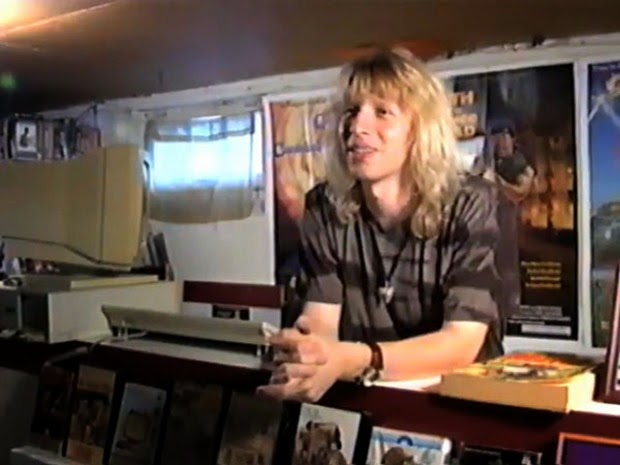
Adjust-Your-Tracking-The-Untold-Story-of-the-VHS-Collector 1

One of the highlights of Adjust Your Tracking comes from the Collector Spotlight segments. This is where the viewer is privy to the impressive collections of Joe Clark and Bradley Creanzo. Both collections will surely cause a tingle of excitement in the viewer’s lower region, especially Creanzo’s, who has gone as far as to completely convert his basement into a fully-stocked video store, complete with all the genres anyone could ask for. It’s truly a thing of beauty for anyone who has any sort of love for VHS.

As someone who grew up with the VHS boom and having it be such a huge part of influencing my love of horror and, eventually, film in general as well as still being a collector of VHS (though, not nearly to the extent of those featured in the film), Adjust Your Tracking is perfectly tailor-made for someone such as myself. However, even if you are not interested in VHS collecting, there is still much to be taken from the documentary. For anyone who is a true movie buff – especially one who loves horror and cult cinema – Adjust Your Tracking is a fascinating and genuine look at a part of movie history that lives on in the hearts of those who've allowed a seemingly dead format to envelop their lives and give them a veritable sense of happiness.

Set for a June 17th release, the Two-Disc Special Edition of Adjust Your Tracking: The Untold Story Of The VHS Collector is available for preorder on Amazon.

Monday, July 30, 2012

Screaming in High Heels: The Rise & Fall of the Scream Queen Era

Screaming in high heels dvd art

Every generation of horror fans has a specific era that they grew up with. Naturally there is a nice transitional overlap from what came before and after, but at the heart of it all there is about a decade of time that sits comfortably in the center of what each fan considers "the good ol' days." For me, personally, that time period would be the 1980s. Not only did I get the overlap of the mid-to-late '70s, but I also watched as horror evolved, and often devolved, into what might be the strangest (and most entertaining) time in horror cinema with the early 1990s. That entire time period from the mid-'70s to the mid-'90s is as gory good as it gets, and the main factor for it being such an awesome time for the genre is the bridge in between.

Screaming in high heels michelle bauerHorror boomed big time in the '80s, and there are a number of factors for this, most notably being the VHS format. VHS took film out of the cinemas and ushered in an era of home video that caused movie fans to go completely bananas, and at the forefront of it all was the horror genre. There was an evolution that genre cinema went through because of home video, and home video itself evolved due in large part to the popularity of genre cinema on the format. As a result, a very specific formula began to prove immensely successful (i.e. profitable) for "non-Hollywood" production companies. Video goers began to yearn for something specific from their rentals; they wanted blood and monsters; they wanted fun and entertainment; they wanted a pair of nice tits on a beautiful woman. And like a perfect storm, all of these things came together and combined to result in the birth of the Scream Queen era.

It is the almighty Scream Queen and the time in which they ruled that is the focus of 2011's Screaming in High Heels: The Rise & Fall of the Scream Queen Era, a documentary that, as promises, looks at the rise and fall of a specific group of extremely popular genre actresses: Linnea Quigley, Brinke Stevens and Michelle Bauer. Often considered some of most notable and certainly three of the most popular horror actresses of the era, "The Terrifying Trio" of Stevens, Bauer and Quigley made a major splash on the home video scene throughout the '80s and much of the '90s, completely changing the landscape of the role women played in low-budget horror. These were the women who went from being the faceless but very "healthy" background babes to being the main selling point of a slew of B-Movies in the '80s and early '90s.

Screaming in high heels

Directed by Jason Paul Collum, Screaming in High Heels follows the typical talking head format that seems to be the gold standard for a majority of film related docs. Outside of the three Scream Queens and their generous insights, interviews come in the form of subject relevant film folk such as Fred Olen Ray, David DeCoteau, Kenneth J. Hall, and a handful of other people who were a part of the scene, all of whom deliver plenty of interesting stories and tidbits for the viewer to chew on. The doc runs the gamut of numerous interesting subjects that cover the era from start to finish, as each Scream Queen speaks of the incredible highs that came with their popularity as well as the negative effects that came along with doing the "types of films" the women were doing. Some of which has followed them up until this very day. The price of fame, I suppose.

Screaming in high heels Linnea QuigleyFor the record, I am a huge fan of film documentaries, particularly ones that are about specific genres or eras of cinema, and outside of the insightful interviews, the doc is chockfull of great movie clips, something that is often a highlight of any film documentary. Also enjoyable is seeing things like television appearances that the girls had made as well as the many ways in which they "busted" their way into pop culture.

Screaming in High Heels certainly delivers the goods by covering a lot of ground; however, while the doc is overall very satisfying, there are two problems that I have with it, one being the runtime (I like 'em long, baby!) and the other being the lack of a fanboy perspective. Now, when I say fanboy perspective, what I mean is Screaming in High Heels could have used some commentary from a celebrity horror fan like an Eli Roth, an Adam Green or whoever could step to the plate and bring that solid fanboy perspective that I, as a fan, can relate to. And in doing so, the runtime of just over 60 min would be stretched out a solid 15-20 min, making the doc's length less of a problem for me.

Regardless of these minor issues, I thoroughly enjoyed Screaming in High Heels: The Rise & Fall of the Scream Queen Era and have no qualms about recommending it to anyone who loves Scream Queens as well as anyone who enjoys this specific time in horror cinema.    

If you'd like to check out Screaming in High Heels for yourself, the horror cable network Chiller shows it from time-to-time, but if you want to see the unedited version, then Breaking Glass Pictures is releasing it on DVD on August 28th. And, depending on your sexual preference, you might want to see this one unedited. *cough-cough lots-of-boobs cough-cough!*

Tuesday, August 30, 2011

20/20 VCR Horror: How VCRs Destroyed America's Youth!

This is a 20/20 piece that aired in 1987 (or at least I believe it's from 1987) that shed much needed light on the 'VCR Horrors' that shattered the lives of children across America, turning them into sadistic serial murderers and rapists. Please, be warned, what you are about to see is filled with more vicious hyperbole than one should ever endure in one sitting.

"Graphic orgies of blood and violence!"

"It's always a female victim, and it's generally in a sexual context"

Dear god, if it wasn't for this informative news report, we all would've been screwed by this point. Imagine if 20/20 hadn't run this story, warning parents about little Suzy and Tommy attending these "gross out parties," the world would be littered with rabid males foaming at the mouth, while the female population would have drastically dropped due to a rash of rape and murder. Certainly a far cry from that cute and cuddly Frankenstein film from 1931 or that shower scene in 1960's Psycho.

It's interesting watching something like this news report, or any one of the many slanderous stories that came from the era covering similar subject matters concerning horror films and their impact on society (Siskel & Ebert or Morton Downey Jr. taking on Slasher films, for example). It brings back the frustrations of a time when censorship ran as rampant as masked serial killers, the MPAA was destroying art in the name of the lord, horror magazines were pulled from shelves to cool off some angry childless adult, and the only ones left to suffer were the fans, who wanted nothing more than to enjoy the genre we love best.

On the other hand, though, when I see a piece like this, it also reminds me of how fucking awesome the '80s were for horror fans. Never was the genre more popular than during the VHS boom, and the censorship and being all pissed off about it is something I look back on quite fondly, to be honest. The controversy surrounding a handful of horror films stirred up incredible interest in those movies for many of us, and the unattainability of certain tapes only made them more desirable. The censorship of the era gave fans something to be passionate about and, in some capacity, may have formed my youthful rebellious ways, which is something I can say is and will always be, a part of my nature.

So fuck you, 20/20. We're still here and so aren't the movies we love, and - outside of that one time behind a Cumberland Farms after buying a chilly dog and a pack of menthols - I have never attempted to rape or murder anyone.

Monday, July 25, 2011

Shock Value: The (R)evolution of Horror

Shock Value

A major transitional period occurred within the horror genre during the 1970s. At the time horror was a genre considered no more than a joke, drive-in fodder for teens to make out to, critics to dismiss, and studios to scoff at. This was a time when thoughts of peace and love were slowly dwindling and being replaced by anger, unease and uncertainty due to the effects of the Vietnam War and a growingly unstable America. These feelings began to show up on screens thanks to a handful of directors that wanted to take the genre in a direction that horror directors before them hadn't, while scaring audiences in a way that they may not have been prepared for. Regardless, these unsuspecting audiences were instinctively hungry for such a change, and they embraced these films as clearly proven by the box-office receipts and cultural impact they had. 

The Last House on the Left 1972New York Times critic Jason Zinoman's book, Shock Value (The Penguin Press), is based off the idea that - while the likes of directors such as Martin Scorsese, Steven Spielberg, and Francis Ford Coppola were making a huge splash at the box-office and on critics - there were a handful of upcoming directors that took the horror genre and pushed it to the next level. Auteurs from John Carpenter, Wes Craven, Roman Polanski, Brian De Palma, and many others started a wave of what Zinoman describes as New Horror. 


Zinoman intricately looks at how this New Horror replaced Old Horror and he does so by focusing on the directors and films directly responsible for such an impactful change in the genre. Shock Value is based on the shift that horror took from creature features and monster mash-ups - that people didn't take seriously anymore in a growingly jaded society – to tales of serial killers without a motive and unexplained occurrences that brought about an ambiguity as to the root of evil, which threw audiences into a frenzy and forever changed the landscape of the genre and how it was perceived. 

john carpenterZinoman ducks and dives into a flurry of narrative that nicely shifts from director to director, bouncing back and forth between each one, connecting them through their influences, their rebellious natures and how their upbringing and lives affected the movies they made, as well as the people around them. Where Shock Value is strongest is in the intriguing information covering the background of these directors and how their films came to be. I often found myself mesmerized by a slew of captivating facts and riveting stories involving directors and films that I love. The overprotective and religious upbringing of Wes Craven; William Castle being bounced from the directors chair in favor of a modern, respectable director in Roman Polanski (the passing of the torch from Old-to-New Horror, as Zinoman describes it); the rift between director John Carpenter and screenwriter Dan O'Bannon after they made Dark Star, and a slew of other vastly interesting stories and accounts that truly make Shock Value a worthy read.

Carrie spanish posterThe detail in which Zinoman goes and the way he weaves much of it together is quite impressive and one of the best aspects of Shock Value. With that said, there are portions of the book that are slightly tedious and overly analytical to the point where there are moments where my mind began to wander a tad. In addition, while Zinoman is clearly a respectable, true fan of the genre, I think that sometimes the horror of the past (pre-70s) is somewhat dismissed as mostly being made up of cheap, hokey B-Movies. But it is clear that he is showing a true affection for the films of the era covered in this book, the films that make up the golden age of modern horror. So it's possible that he is more or less just fully championing this era that he clearly loves, thus pumping it up slightly by taking the piss out of the cinema that came before it.

Where Shock Value focuses on the golden age of New Horror from the '70s, to me, it almost begs to ask the question of where the next wave of such influential horror is to come from. While I think Jason Zinoman is looking at things specifically from a theatrical standpoint - which is where all of the films he discuses made their incredible impact on culture, society, genre fans, and filmmakers for many years to follow - I think that holding leatherfaceones breath waiting for such a cinematic trend to ever reoccur on such a level is not conducive to a long life. If you were to take this notion of New Horror and applied those attributes to our modern cinema, many of these films simply wouldn't make it to the big screen. Instead, they would be relegated to no more than a short theatrical release, festival runs and eventually land straight onto DVD where the New-New Horror now resides.

The next level is upon us; the new golden age comes from films that will make their impact on those that seek them out, just not on the ones that would go to the cinema to see any old thing. They have mostly been factored out of the equation, thus making it difficult to ever have the impact of a Texas Chainsaw Massacre again. Films like Let the Right One In, Martyrs, Audition, and any number of challenging films that come along now would simply get lost in the shuffle, if they were to even have the chance to ever see the light of theatrical day, that is (though there are a few that do break through, thankfully). Hollywood takes very little in terms of risks, this we all know, so I cannot imagine that we will ever be so lucky to have an era cinematically as great as the '70s, but at least we can enjoy them in the next best way: in our living rooms with a bowl of reasonably priced popcorn and 40oz of Old English.  


You can nab yourself a copy of this here fine book over at Amazon for a very reasonable price, and if you want to read more about Shock Value as well as the author, Jason Zinoman, you can stop by the TLC Book Tour page.    

Monday, January 4, 2010

Dial M For Magnificent!

dialm There's just something satisfying about watching an older film and being nearly blown away by the techniques and visual stimulation used in something that is considered to be “old.” I have seen my fair share of Alfred Hitchcock films, but fair share compared to his “girthy body“ of work is nearly a sliver in the big scheme. I love the films of his that I have seen, but I think I have been much too lax in broadening my Hitchcock horizons and for no good reason. I get this way whenever I watch one of his films too and last time was with Strangers on a Train, a film that I completely adored and one that made me think I should watch more of his films...much like I am thinking and telling you right now. dialm1

Maybe it's a good thing that I take time between his films, maybe it makes me appreciate them more when I do see them? If I went into another one of Hitchcock's films right now, all high off the  celluloid extraordinariness - would I be disappointed? Perhaps, but that's just bullshit excuses and I think this cycle all ends with a film by the title of Dial M for Murder. Words cannot express how much I enjoyed this film, but words expressing my enjoyment are kind of key in writing about it, so I better come up with something I guess. 

Tony (Ray Milland) has concocted an intricate plot to murder his wealthy, but unfaithful wife, Margot (Grace Kelly). Tony was a professional tennis player and spent a good portion of their marriage playing dialm2in tennis tournaments, while his beautiful wife sat all alone back home in jolly ol' England. Bored and before soaps, Margot needed a little “manly attention” while Tony was away and she got it from an American crime novelist named Mark (Robert Cummings), who was staying in England for a short period of time. Tony knows of this adulteress event and along with Margot being extremely wealthy, his motivations are all lined up and gives him all the reasons one would need to have his wife murdered. 

Mark is now back in England for a visit and has met and befriended Tony to an extant, but that friendship is all a facade on both of their respective ends as Mark is really in love with Margotdialm3 and Tony knows about their affair. How Tony found out in the first place was a letter that Mark had written to Margot when he left England to go back to America -  Tony got his hands on the letter and actually uses it to play an integral part in his scheme to kill Margot. That's kind of the short of it all as the plot for this film is very intricate, but more so, spoiling any of it would be reprehensible on my part no matter how old this film may be.

Most of the focus is on these three characters and almost the entire film is set in a singular location, which would be Tony and Margot's flat. Much of Dial M is filled with exposition and most of the movie is characters talking about or explaining something to move the plot along. Sounds kind of boring...one location, a few characters, and nuttin but talking. However, this one is far from boring and I was dialm5completely intrigued by the intricate details of every move that each character makes, or plans on making. Tables are constantly turned, backs are stabbed multiple times and there is no clear indication as to how things may turn out in the end.

Dial M for Murder is based off a stage play by English playwright Frederick Knott, who also wrote the film's screenplay and the detail put into it is incredible. Every detail is meticulously thought out and as each character explains their plan, it is impossible not to be amazed by the brilliance of it all. Tony's perfect murder scheme is so well thought out and so tight, that there is no way it wouldn't work in his mind and this almost gives him an arrogance about the whole thing. Arrogance leads to mistakes and when one is made, the plot thickens as well as the mystery and tension.

dialm7 Even with all of the long periods of talking throughout the film, Hitchcock is somehow able to make each of these dialogue stretches seem different from one another with a multitude of techniques and camera angles. Dial M is set in one location, but even more so, one main living room and the way that room is shot in so many different ways is an astonishing sight. One long scene towards the film's opening has Tony explaining his murder idea to an unwilling accomplice - as Tony starts acting out how it should all go, the camera jumps to a high angle, almost top down view and in a voyeuristic way, follows every movement that Tony makes. It is quite brilliant and really draws you in to what Tony is saying, which is very important, because the entire film relies on being captivated by the narrative. dialm8

There are so many different little stylistic flourishes that keep you from just staring at a couple of talking heads and no matter how interesting what is being said is, without the visual prowess, it could get a little boring. It certainly doesn't hurt the film that the acting is superb by all involved either and especially with these long scenes of heavy dialogue that are often delivered for lengthy periods of time with very few cuts.  It plays exactly like a stage play and considering that is where the source material stems from, the feel is more than fitting.

dialm6

Dial M for Murder is a perfect case of all style AND substance and that is a balance not struck often enough. When this balance is found in a film that's 55 year's old, it just makes it that much more impressive to me...I don't know why that is exactly. Probably naivety, or the fact that I have a predetermined thought of movies or “pictures” from that era and how they are stylistically. Hitchcock was leaps and bounds ahead of the curve and it is great to once again be shown why he was such a master, by viewing the phenomenal Dial M for Murder.

Tuesday, December 15, 2009

The Glamourous Side of Hammer

When people think of Hammer films, they think dignity, respect, atmospheric horror films, elegance, and class. When people think of Hammer films, they think of great actors like Peter Cushing, and Christopher Lee, performers of the highest degree and some of cinemas finest. When some people think of Hammer films, well, they just cannot help but think how bangin' those women were in those movies! I would be a little bit of "all of the above," but my whole reason for being here this fine and frigid evening is to talk about the incredible ladies of Hammer studios, the beautiful women that graced the silver screen and the hearts of many a young man and woman.

I recently got my hands on Marcus Hearn's Hammer Glamour (Titan Books), the 160 sticky page tribute to the beauties of Hammer Horror over its reign of cinema terror. Filled to the tippity top with rare and unpublished full color photographs from Hammer's archives and private collections, Hammer Glamour is a lavish celebration of cinemas most amazing women. There are plenty of interviews, some of them new and each actress gets a nice insightful retrospect talking about their careers inside and out of the Hammer studio system.

If there is one thing I love, beside busty women, it is documentaries, books and behind the scenes of film, film history and how things have come to be where they are today. Hammer has one hell of a history and to learn the female aspect of it is quite fascinating. The stories of how films were sold based off a good looking, new starlet on some fake poster for a film not yet written is incredibly interesting. Hammer Glamour and the women behind it were a major part of Hammer's success and they could almost be looked at as the unsung heroines that pushed the company and their films popularity just that one-step further than they did with just the characters of Dracula, or Frankenstein. Hammer intrigued many young people with the threat of monsters and horror, but in a different way, these films also intrigued many a youth with the beauties that were to be found within each and every film.

Some of the interviews are very candid and honest, with some very likable women, others are a little tougher to enjoy, as some of them were not really into doing "horror" movies, which is as always, a let down. What really stands out though, are the photos and there are an abundance of amazing pictures of each and every lady in this book with some very nice candid behind the scenes shots to be viewed. One of my favorites is a behind the scenes shot of Christopher Lee and Stephanie Beacham from 1972's Dracula A.D. where it's clear that Beacham must have said some sort of corny joke and is dying from laughter about it, while Lee has a look on his face as if he cannot believe what she just said. Very candid and kinda cute, it's the type of photo that makes a book like Hammer Glamour work beyond the just photos of good looking girls.

As for the ladies themselves, well, most all of the important ones are here and it just does not get any better than having them go in alphabetical order. Why? Because you start off with the almighty Ursula Andress at A and the book finishes with W and that W can only stand for one woman...Raquel Welch. Talk about perfect 10 bookends! Those being two of my favorites and probably two of the best-known women to come through the Hammer ranks, it's very interesting hearing their thoughts on their Hammer past. My personal favorite of all these women? Well, that comes from the last of the Hammer movies and that's Nastassja Kinski from the film, To The Devil...A Daughter. Cat People indeed.

The presentation is top notch all around, as are the women, so if you're a fan of Hammer films, horror history, and mad hot babes, or even just one of the three, Hammer Glamour is a must.

Most Popular Posts

Chuck Norris Ate My Baby is in no way endorsed by or affiliated with Chuck Norris the Actor.